
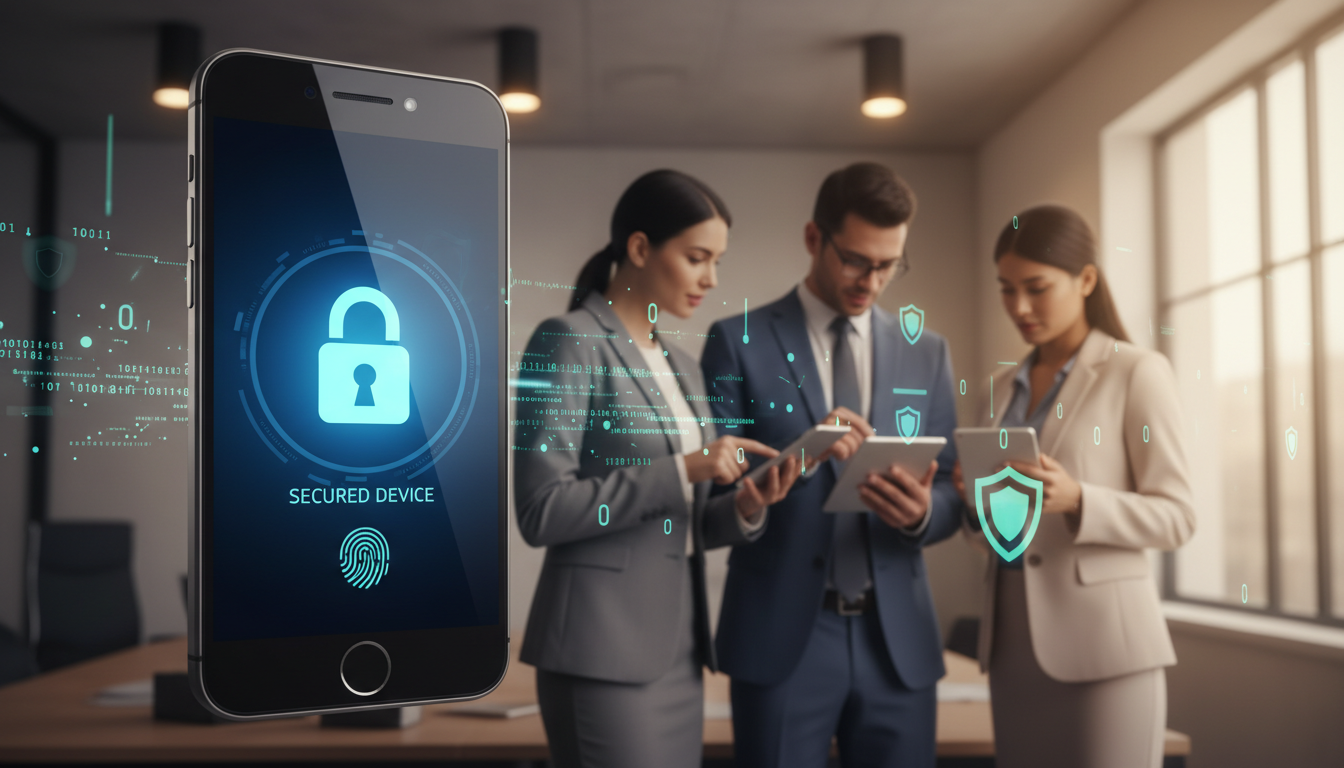
If you unlocked your phone right now and handed it to a stranger, what could they learn about you in under sixty seconds? Your home address, your bank balance, private conversations, maybe even your medical history. Most of us carry more sensitive information in our pockets than we keep in a filing cabinet at home.
The uncomfortable truth is that mobile devices weren’t originally designed with privacy as a priority. They were designed to be convenient. And convenience, by default, often works against security. Every app that remembers your login, every browser that saves your card number, every photo tagged with GPS coordinates — these are trade-offs we make without thinking.
This guide isn’t about turning your phone into a fortress. It’s about making deliberate choices that protect what matters most, without sacrificing the usability that makes these devices worth carrying in the first place.
Why Mobile Devices Are Uniquely Vulnerable
Desktop computers sit behind routers, firewalls, and often corporate security infrastructure. Your phone, on the other hand, connects to dozens of different networks every week — coffee shop Wi-Fi, airport hotspots, hotel networks, your friend’s guest network. Each connection is a potential exposure point.
But network vulnerability is only part of the picture. Mobile devices face three compounding risks that desktops don’t:
- Physical exposure: Phones get lost, stolen, or left unattended far more often than laptops. A 2024 survey by Prey Project found that a smartphone is lost or stolen every 3.5 minutes in major cities.
- App ecosystem complexity: The average person has 80+ apps installed, each with its own permission set, data collection practices, and update schedule. Managing this manually is nearly impossible.
- Always-on connectivity: Unlike a laptop you close and put away, your phone maintains persistent connections to cellular networks, Bluetooth devices, and background services around the clock.
Understanding these structural vulnerabilities is the first step toward meaningful protection. You can’t defend what you don’t understand.
Start With What You Already Have: Built-In Security Features
Before installing any third-party security app, make sure you’re fully using the tools already built into your device. Both iOS and Android have invested heavily in native security — but many of these features are disabled by default or buried in settings menus.
Lock Screen Configuration
Your lock screen is your first line of defense, and it’s worth getting right. Here’s what matters:
- Use biometrics as your primary unlock method. Fingerprint and face recognition are both faster and more secure than PINs for daily use. They can’t be shoulder-surfed, and they make locking your phone effortless.
- Set a six-digit alphanumeric passcode as your backup. Skip the four-digit PIN. A six-digit code with letters multiplies the possible combinations from 10,000 to over 2 billion.
- Reduce your auto-lock timer to 30 seconds. Yes, it’s slightly less convenient. But the window between setting your phone down and it locking is exactly the window a thief needs.
Find My Device
Both Apple’s Find My and Google’s Find My Device can remotely locate, lock, and erase your phone. But they only work if they’re activated before you need them. Take thirty seconds right now to verify:
- The feature is enabled in your settings
- Location services are on for the tracking service
- You can log into the web interface from another device
App Permissions: The Silent Data Leak
When was the last time you actually read an app permission request before tapping “Allow”? Most of us treat these prompts like cookie banners — something to dismiss as quickly as possible. But permissions are where the real data exposure happens.
The Permission Audit
Set aside ten minutes this week for a permission audit. Go to Settings → Privacy (iOS) or Settings → Apps → Permissions (Android) and review these categories:
- Location: Which apps have “Always” access? Most should be set to “While Using” or “Never.” A weather app needs your location when you open it, not at 3 AM.
- Camera and Microphone: Social media and messaging apps need these. Your calculator does not. If an app has access it shouldn’t, revoke it immediately.
- Contacts: Many apps request contacts access to “find friends.” What they’re actually doing is uploading your entire address book to their servers. Only grant this to apps you genuinely use for communication.
- Photos: Consider using “Selected Photos” access (iOS) or granting access only when the app is in use. Full photo library access means an app can scan every image you’ve ever taken.
The Two-Week Rule
Here’s a practical approach: if you haven’t opened an app in two weeks, it probably doesn’t need any permissions at all. Revoke them. If the app breaks without a permission, you’ll know when you use it next — and you can make a conscious decision about whether to re-grant access.
Passwords and Authentication: Beyond the Basics
You’ve heard the advice: use strong, unique passwords for every account. But let’s be honest about why most people don’t follow this advice — it’s impractical without a system.
The Realistic Approach
A password manager is the single most impactful security tool you can adopt. It eliminates the need to remember dozens of complex passwords and removes the temptation to reuse them. Here’s how to implement one without friction:
- Start with your device’s built-in option. Apple Keychain and Google Password Manager are free, automatic, and already integrated into your phone. They’re not the most feature-rich options, but they’re infinitely better than reusing passwords.
- Migrate gradually. Don’t try to change every password at once. Each time you log into a service, let your password manager generate and save a new strong password. Within a month, you’ll have covered your most-used accounts.
- Protect the master password. If you use a third-party manager like Bitwarden or 1Password, your master password is the one password you need to memorize. Make it a passphrase — four or five unrelated words strung together. “correct horse battery staple” is both more secure and easier to remember than “P@ssw0rd!23”.
Two-Factor Authentication: What Actually Works
SMS-based two-factor authentication (2FA) is better than nothing, but it’s the weakest form. SIM-swapping attacks — where criminals convince your carrier to transfer your number to their SIM — can bypass SMS codes entirely.
For meaningful protection, use an authenticator app (Google Authenticator, Authy, or Microsoft Authenticator) for your most important accounts: email, banking, and social media. These generate time-based codes on your device that can’t be intercepted remotely.
For your most critical accounts — primary email, financial institutions — consider a hardware security key like YubiKey. It’s the gold standard, and it takes less than five minutes to set up.
Network Safety: What You Connect To Matters
Public Wi-Fi isn’t inherently dangerous — that’s a common misconception. Most modern web traffic is encrypted via HTTPS, which means a coffee shop hacker can’t simply read your bank password off the network. But public networks do create risks in more subtle ways:
- Captive portals and fake networks: An attacker can create a Wi-Fi network named “Starbucks_Free” and redirect traffic through their device. Your phone might connect automatically if it’s seen a similarly-named network before.
- DNS manipulation: Even with encrypted traffic, an attacker controlling the network can redirect you to convincing fake versions of real websites.
- Metadata exposure: Even if your data is encrypted, an observer can see which services you’re connecting to, when, and how often.
Practical Network Habits
- Disable auto-join for public networks. Manually select and connect only when you need to.
- Use cellular data for anything sensitive — banking, email, shopping. Your carrier’s network, while not perfect, is significantly harder to intercept than public Wi-Fi.
- If you regularly work from public spaces, a reputable VPN is worth the investment. Look for providers that have been independently audited and have a clear no-logs policy. Mullvad, ProtonVPN, and IVPN are consistently well-regarded by security researchers.
Daily Habits That Compound Over Time
Security isn’t a one-time setup — it’s a set of habits that become automatic. The most effective long-term protection comes from small, consistent actions rather than occasional overhauls.
Weekly (2 minutes):
- Install any pending system and app updates
- Delete apps you haven’t used in a month
- Check your phone’s storage for unexpected large files (potential malware downloads)
Monthly (10 minutes):
- Review app permissions (use the audit method above)
- Check your email’s “Connected Apps” or “App Passwords” section for unfamiliar entries
- Verify that your backup is running and encrypted
- Review your password manager for weak or reused passwords
Quarterly (30 minutes):
- Review your accounts at haveibeenpwned.com for any new breaches
- Update recovery information (phone numbers, backup emails) on critical accounts
- Review and revoke OAuth connections (“Sign in with Google/Facebook”) for services you no longer use
What to Do When Something Goes Wrong
Despite your best efforts, breaches happen. Having a response plan is just as important as prevention. If you suspect your device or accounts have been compromised:
- Change passwords immediately — starting with your email (since password resets for other services go there), then banking, then social media.
- Enable a device lock or remote wipe if the phone is lost or stolen.
- Check for unfamiliar account activity — login history, sent messages you didn’t write, purchases you didn’t make.
- Contact your bank if financial information may be exposed. They can flag your account for suspicious activity.
- Document everything — screenshots of suspicious activity are valuable if you need to file reports with authorities or dispute charges.
The Bigger Picture: Privacy as a Practice
Perfect security doesn’t exist. Every security measure involves a trade-off between protection and convenience. The goal isn’t to eliminate all risk — it’s to make informed decisions about which risks you’re willing to accept.
Eva Galperin, Director of Cybersecurity at the Electronic Frontier Foundation, advocates for “threat modeling” — identifying who might want your data, what data they’d target, and how they’d try to get it. A journalist protecting sources has different needs than a parent protecting family photos. Your security setup should reflect your actual situation, not a theoretical worst case.
The strategies in this guide are designed to cover the threats that affect most people, most of the time. They won’t make you invisible to a nation-state adversary, but they will make you a significantly harder target for the opportunistic threats that account for the vast majority of real-world incidents.
Start with one section. Implement it fully. Then move to the next. Incremental improvement, consistently applied, is what actually keeps your data safe over the long term.

Hi, I’m Isabela! With over 8 years in Information Technology, I’ve helped individuals and businesses navigate the ever-changing world of digital tools. I specialize in device optimization, app recommendations, and online security — breaking down complex tech concepts into clear, actionable advice anyone can follow.